
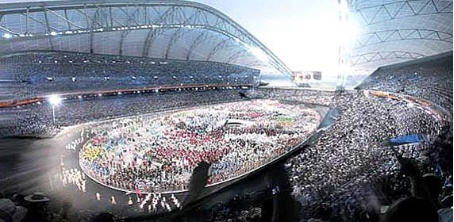
 The changing configuration of the roof of huge sports and public facilities has long been no surprise. But even in the setting of private households, a movable roof appears more and more often. How complex is it in equipment, and is it possible to arrange it yourself - this article will tell about this
There are cases when the owner of a country cottage would like some of the structures on the site, and maybe the house itself, to be able to respond to weather changes or a change in the time of day.
For example, there is a greenhouse on the site, and it makes no sense to keep it closed all year round. For such cases, various types of movable roofs are designed.
According to the device, they can be:
- Removable - when the entire roofing part is completely removed from its place - in whole or in parts (although it is difficult to call such a sliding roof)
- Mobile - when the entire roof moves completely from place to place
- Sliding - when different parts of the roof move in different directions
- Partially movable - when only one section of the roof is movable
In most cases, sliding roofs are used for the following structures:
- Pools
- Greenhouses and conservatories
- Cafe
- Sports grounds
- Recreational areas
- Parking lots
- observatories
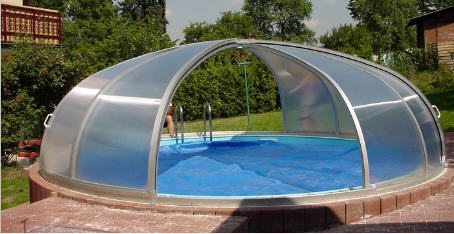
According to the functionality of the structure where movable roofs are equipped (as well as the roofs themselves), they can be divided into:
- Capital - stationary structures that are operated year-round and constantly
- Seasonal - which are operated only some time during the year
- Temporary - various portable structures that are used as needed, such as awnings, or tents for picnics
You can also classify the structures themselves according to the degree of their combination with "fixed" buildings:
- Embedded
- Attached
- Freestanding
How difficult is it to make a do-it-yourself sliding roof? It depends on the scale of the structure, the degree of its capitalization and the requirements for aesthetics.
At the heart of almost any movable structure are guides of one kind or another. They allow you to move the mobile segment to the right place and back, at the same time, holding it in the right position.
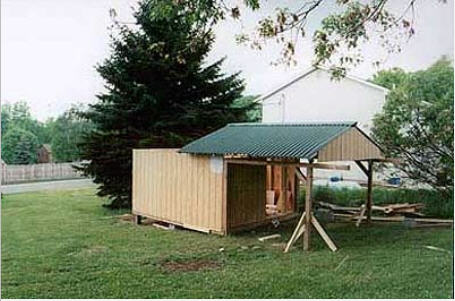
At the same time, the guides can be straight - and then the elements really move, going beyond the basic structure, and curvilinear (usually forming a circle or part of it) - respectively, and the roof will turn out to be movable.
In the second case, special rollers will be required for a sliding roof, a more complex design than for straight guides.
ADVICE! Even for structures with curved structures, in most cases solutions can be found that allow the use of straight guides. Possible inconvenience will pay off in the future ease of use.
What will be the main elements of the roof movement system in general, and what should be decided when designing it? This:
- Way of transportation (same guides, tracks, etc.)
- Way of movement (rolling, carrying, lifting)
- Drive (the power unit that makes the system work; in simple cases, this may be the homeowner himself, possibly using mechanical devices such as winches or hoists)
- Storage space - may be required for seasonal or temporary structures
Naturally, it makes sense to arrange solid systems for capital structures that will last for many years, and where such systems will be used constantly. However, they can be quite simple to implement.
The same sliding roof for the pool will turn out to be quite satisfactory if it is arranged using several profile strips laid on a dense base and rollers of the simplest design.
ADVICE! When arranging sliding structures, it is better to try to make them telescopic. In working condition, they will work just as well as any other system, and when assembled, they will take up much less space.
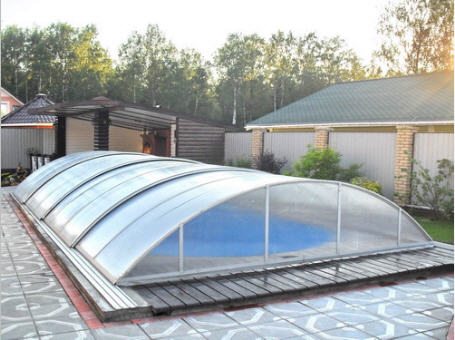
Of course, organizing a sliding roof segment on your own is a rather complicated matter, and requires careful calculation of structures and a professional approach. But simpler solutions, such as a "retractable" conservatory or a pool with a retractable roof, are a reality.
When planning a mobile roof for a structure, the following main points should be determined:
- With what seasonality and frequency will the facility be operated
- What are the temperature requirements?
- What type of structure will be
- What materials will it be made from?
- In what direction and due to what will the prefabricated segments move
- How to prevent spontaneous movement of structures
Given the fact that there are now many lightweight and durable materials (such as polycarbonate, aluminum or titanium), the technologies for their use are well developed, for most structures a movable roof is a completely possible solution.
Did the article help you?